Kontakt Flappe öffnen
The future is now

How AI is Rewiring the World of Logistics

AI is changing the way logistics works – and faster than many expect. Discover how artificial intelligence can cut quoting and booking times from 30 minutes to under two, reduce manual workloads by more than half, and improve data accuracy and visibility. Get an insight into how cargo‑partner is testing and applying leading-edge AI tools to streamline operations and enhance customer service.

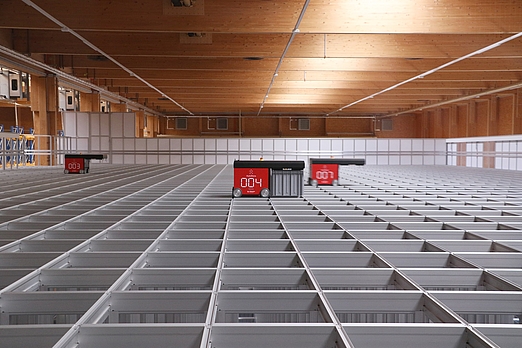
In global logistics, every delay has a cost. Quoting a shipment can take 20 to 30 minutes of manual work: reading emails, checking rates, and preparing documents. AI can now perform these steps in under two minutes, with human review only where it matters. This capability is already transforming freight operations, cutting routine workloads by more than half and allowing teams to focus on exceptions and customer care.

Breathtaking advancement

Recent surveys confirm that adoption of AI tools in the logistics industry is accelerating. A study conducted by the thinktank Inform in the summer of 2025 shows that around 90% of the companies surveyed see great potential in AI agents for automating and increasing the efficiency of logistics processes, with 12% already using them productively and 25% in the testing phase. The most important areas of application identified in the study were sales planning, demand forecasting, inventory management, and risk assessment – while the well-known challenges primarily lie in data quality, system integration, and training requirements.

Generative, Agentic, and Enterprise AI – Do You Know the Difference?

AI in logistics can take different forms, each serving distinct purposes. Understanding these categories helps clarify how AI can be applied to solve specific operational challenges:

  • Generative AI creates new content such as text, images, or data based on learned patterns.
  • Agentic AI acts autonomously within defined parameters to complete tasks or make decisions.
  • Enterprise AI refers to AI systems integrated into business processes, designed for scalability, compliance, and security.

The Hidden Cost of Manual Work

Despite years of digital transformation, much of the daily work in logistics remains invisible to management systems. Studies show that operators still spend up to 60% of their time outside core platforms, handling requests through emails, Excel files, and carrier websites. Critical communication happens across disconnected channels, leaving managers to steer with incomplete or delayed information. The consequences are familiar: higher costs, slower responses, lower service quality.

Why Logistics Needs AI

Valuable data already exists across the logistics chain – in emails, attachments, standard operating procedures (SOPs), and PDF documents – yet it often remains locked in silos. Common reporting systems typically reconstruct what happened days or weeks later, offering a rear-view mirror instead of a live dashboard. This is where AI, and particularly generative and enterprise AI, come into play. These technologies can read unstructured communication, connect data points across platforms, and present information as actionable insight in real time, rather than just producing static reports.

From Theory to Practice: AI at cargo‑partner

While many companies are still exploring the potential of artificial intelligence, some have already integrated it into daily operations. cargo‑partner has adopted a multi‑platform approach, testing and combining several technologies to address different aspects of logistics workflows.

One such tool is the company’s own GPT-based AI assistant. It provides every employee with on‑demand support for tasks such as drafting documents, summarizing information, and analyzing data to help teams work more efficiently.

Complementing this, Google and AWS AI platforms power dynamic search tools and knowledge bases, allowing faster and more precise information retrieval. These capabilities are supported by an AI Champions & Training Program, which builds skills across teams to ensure effective use of the technology.

Perhaps the most transformative application is an AI-powered operators’ co-pilot designed specifically for logistics optimization. The advanced platform serves as a backbone of global trade by automating critical freight-forwarding workflows such as rate requests, bookings, document extraction and arrival-notice handling.

Ondřej Cikhart, Chief Information Officer at cargo‑partner, explains: “What makes cargo-partner’s AI strategy unique is our way of working. We experiment fast, learn from pilot projects, and scale what works globally. AI won’t replace people in logistics – it will redefine their roles. As intelligent systems take over routine execution, our teams will focus even more on coordination, innovation, and building strong partnerships.

The Role of the AI Operators’ Co‑Pilot

cargo-partner is currently testing this AI-powered co‑pilot for transport operations – but how does it work? Think of it as a tireless assistant who reads every incoming email the moment it arrives, understands what the customer needs, and gets the process moving without delay. It follows the defined workflow, checks the details, and hands over to a human only when a decision or verification is needed.

Here are a few examples:

  • Quoting in Minutes, Not Half an Hour
    A customer writes: “Dear freight team, I have a new project ex CN–FRA, LCL, Incoterm DAP…” with all pallet details included. The co-pilot instantly spots the transport mode, checks if there’s an SOP for this customer, pulls rates from the system, and sends back a polished PDF quote. The customer has their offer in minutes, not 30 minutes later.
  • Spotting Missing Information
    An air freight request arrives, but the origin address is incomplete. The co-pilot flags the gap and sends a quick clarification email to the customer, so the process keeps moving without guesswork.
     
  • Following Dangerous Goods Protocols
    Three containers of scooters with lithium batteries? The co-pilot knows this is dangerous goods and routes the request to the pricing desk team. Once they respond, it picks up the thread and sends the quote to the customer.
     
  • Handling Bulk Rate Requests
    A regular customer asks for rates for seven port pairs for the next month. Instead of manually checking spreadsheets, the co-pilot queries the rate management system for each route, adds trucking and on‑carriage charges, and sends one complete email with all the quotes.

A Measurable Impact

At cargo-partner, AI is already delivering measurable results. It can cut manual effort on routine tasks by more than 50%, automate communication with customers and partners, and reduce email back-and-forth, leading to faster response times. It improves data quality and compliance, providing managers with real-time visibility into operations.

Perhaps most importantly, it frees teams to focus on higher-value work – exception handling, customer care, and continuous improvement – rather than repetitive data entry. And the effects are tangible: faster turnaround times, greater accuracy, and stronger relationships between forwarders, carriers, and customers.

What Does the Future Hold?

Artificial intelligence in logistics is moving from isolated pilots to fully embedded operational tools. As capabilities expand, AI will not only accelerate quoting and booking but also manage complex workflows end‑to‑end, from demand forecasting to real‑time disruption response.

Ondřej Cikhart, Chief Information Officer at cargo‑partner, anticipates: “The real transformation happens when AI becomes part of everyday decision‑making, not just a separate tool. It’s all about giving our teams the right information at the right time, so they can act faster and with greater precision.” The pace of change is rapid, and those who adapt early will set the standard for speed, transparency, and service quality in the decade ahead.